
Liquidation preference explained: who gets paid first at exit
How a liquidation preference decides who is paid first at exit, with 1x, 2x and participating terms worked through, and what to check as an angel.
In short
- A liquidation preference pays one class of shareholder a set amount before ordinary shareholders receive anything.
- The multiple, whether it participates and where it ranks decide how much it costs everyone else.
- It bites in modest exits. In a large exit a non-participating preference usually disappears into conversion.
- A later investor's preference can sit ahead of your cheque, so read the ranking before you invest or follow on.
When a company is sold or wound up, the proceeds do not split by ownership percentage. A liquidation preference sets who is paid first, and how much, before anyone else shares in what is left. For an angel it is one of the terms that most changes what a cheque is worth in an ordinary outcome.
What a liquidation preference is
It is a right attached to a class of shares, usually the preference shares issued to a later investor. It sits in the articles of association and the shareholders' agreement. On a sale, a winding up or another defined exit, the holders of those shares are paid a set amount before ordinary shareholders receive anything. That amount is normally a multiple of what the investor paid.
Founders and employees usually hold ordinary shares. Angels hold whatever class their round issued, so check which class yours is.
The three terms that matter
- The multiple. 1x returns the amount invested. 2x returns twice that. 1x is the market norm: Carta found that 1.9% of primary seed and Series A rounds on its platform carried a preference above 1x in the first ten months of 2024.
- Participating or not. A non-participating investor takes the greater of the preference or their share if they convert to ordinary shares. A participating investor takes the preference and then also shares in the remainder as if they had converted. Some participating terms are capped at a total multiple.
- Ranking. Preferences can be stacked, with the latest round paid first, or pari passu, with every preference holder paid in proportion. Ranking decides whether an earlier investor sits behind a later one.
A worked example
An investor puts in £1m for 20% of a company, a post-money valuation of £5m. The table shows how a sale at three prices splits between that investor and everyone else, under three sets of terms. It ignores debt, fees and any other share classes.
| Sale price | 1x non-participating | 1x participating | 2x non-participating |
|---|---|---|---|
| £2m | £1.0m / £1.0m | £1.2m / £0.8m | £2.0m / £0.0m |
| £5m | £1.0m / £4.0m | £1.8m / £3.2m | £2.0m / £3.0m |
| £10m | £2.0m / £8.0m | £2.8m / £7.2m | £2.0m / £8.0m |
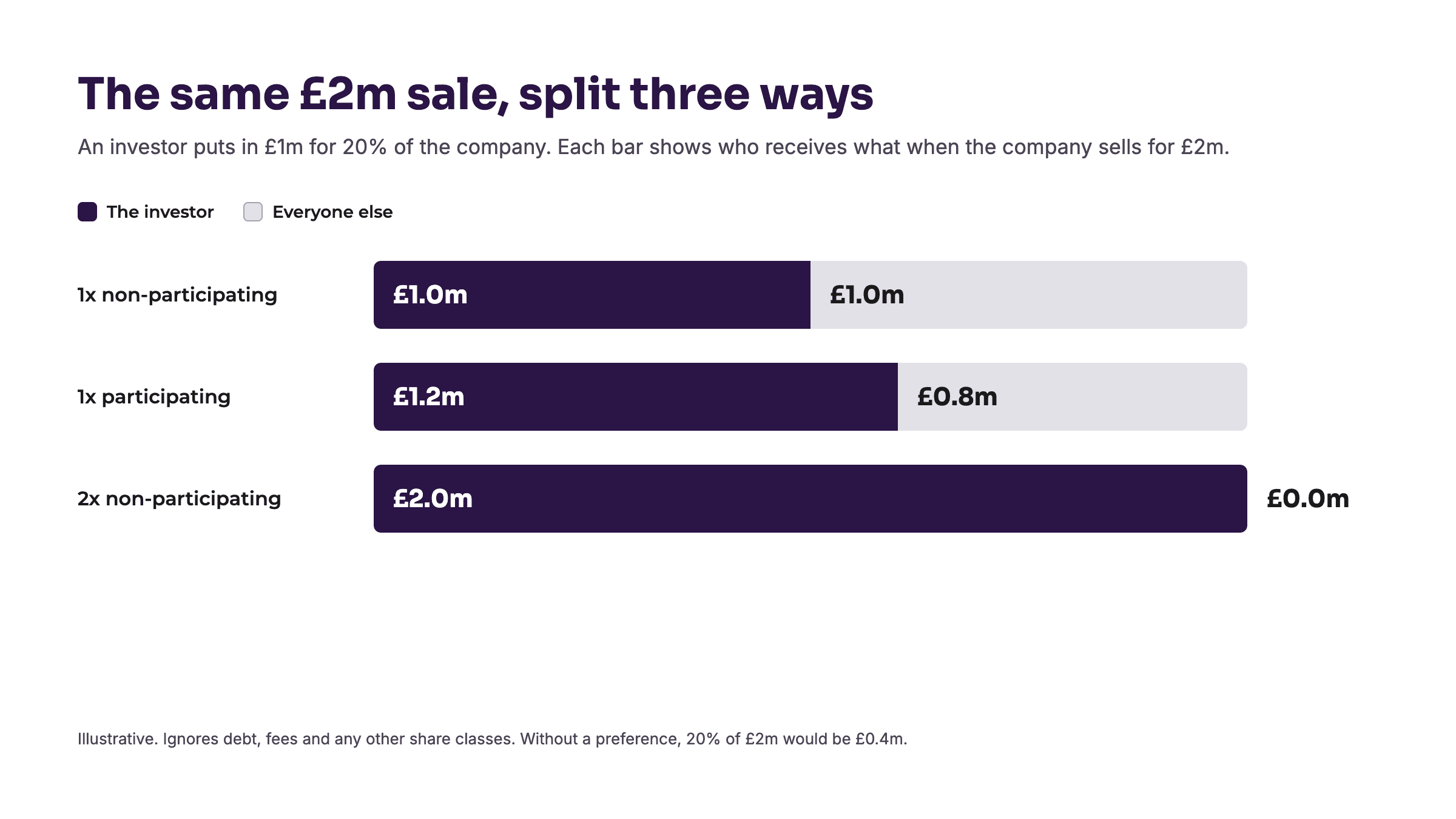
At a £2m sale, 20% of the proceeds would be £0.4m. The 1x preference pays the investor £1.0m instead, which leaves the other 80% of the shares with £1.0m, not £1.6m. At £10m the 1x non-participating investor converts and takes £2.0m, so the preference has no effect. The participating investor still takes the extra £0.8m, because the preference is paid on top of their share. A 2x preference leaves ordinary shareholders with nothing at £2m and with the same £8.0m at £10m.
Exit waterfall calculatorSee who is paid what at an exit, preferences first.Open the calculatorWho it helps and who it hurts
Preferences matter most in modest exits, which are the common outcome for early-stage companies. In a large exit a non-participating preference usually vanishes, because converting pays more.
For an angel the sharper risk is ranking. If a later round is paid first, its preference sits ahead of your cheque. A valuation that looks fine on paper can be worth much less to the earliest shareholders at a middling sale price. That is also why a portfolio mark based on a round price can overstate what you would receive, as the piece on DPI, TVPI and XIRR explains.
What to check before you invest or follow on
- The multiple. Anything above 1x deserves a reason.
- Participation. Ask whether it participates and whether there is a cap.
- Ranking. Find out whether preferences are stacked or pari passu, and where your class sits.
- Dividends. Accrued or cumulative dividends can add to the amount paid ahead of you.
- Your own numbers. Model a low, a middle and a high exit before you sign.
The exit waterfall calculator lets you test terms like these against your own cheque and ownership.
Questions angels ask
It entitles the investor to receive the amount they invested, once, before ordinary shareholders are paid. After that, the rest is shared according to the terms. 1x is the common market norm.
A non-participating investor takes the greater of their preference or their share if they convert to ordinary shares. A participating investor takes the preference and then also shares in what is left, so they are paid twice on the same shares.
Yes. If the sale price is no higher than the preferences ahead of the ordinary shares, those preferences absorb all the proceeds and ordinary shareholders receive nothing.
No. In Carta's data, 1.9% of primary seed and Series A rounds in the first ten months of 2024 carried a preference above 1x. Treat anything higher as a term to question, not a default.