
Nine in ten investors think your price is wrong.
Three in a hundred will tell you.
Most rounds do not fail in the meeting. They stall on a number nobody says out loud. Build a valuation an investor can check, before the first call, from your own figures.
Included on the Featured plan. $29 a month or $299 a year. Investors never see your inputs, only the range we confirm.
- Ask sits inside the range
- No financial model behind the forecast. Investors will ask for it.
Illustration. Figures are an example, not a benchmark.
- Headline seed valuations against the median round
- 4.6x
- Carta, Q2 2025
- Median gap from seed to Series A, up from 1.5
- 2.1 yrs
- Carta, 2025
- Rounds that reprice the company lower than the last
- 1 in 5
- Carta, 2024
- What founding teams still own after Series A
- 36%
- Carta, Founder Ownership 2025
Six facts about the round you are about to price
None of them are opinions. Each one has a source you can open. Read them in order and the problem names itself.
Fact 01. The valuation you read about is in the top 5 percent. Yours will close at a quarter of it.
The seed rounds that make the news sit at the 95th percentile. In 2019 they were 3.7 times the median round. By 2025 they were 4.6 times. The median rose too, but the gap between the headline and the typical round has never been wider.
When you set your number, which of these two lines did you look at?
Fact 02. Investors see the price as wrong and almost never say so.
A pass on price arrives as "not a fit for us right now". So you fix the deck, tighten the story and send it again. The number stays wrong, and the next investor passes for the same unspoken reason.
How many investors have told you the price was the problem?
Fact 03. Your seed round has to last two years, not eighteen months.
The median gap between a priced seed round and a Series A was 1.5 years in 2019. It is 2.1 years now. Two in five companies that reach Series A take more than three years to get there. A round priced for the old timeline is priced for a market that no longer exists.
How long is your seed money meant to last?
Fact 04. Fewer than one in five of you will raise a Series A inside two years.
Most seed companies bridge, extend or stop. Seed bridge rounds rose from about 31 percent of seed rounds in 2022 to about 46 percent in early 2025, and companies that bridge reach Series A about half as often. The round you price now has to carry you further than any seed round before it.
What happens if the next round does not come on time?
Fact 05. If you price this round wrong, the next one is a down round before it starts.
Down rounds ran at one in twenty in 2021. Since 2023 they have sat at one in five or more for eleven straight quarters. Most of them are Series A and later, which is the point: the seed price you set now is the reference the next round is marked against.
If you raise again in two years, which way does the price move?
Fact 06. You will sell a fifth of the company in this round. Sell it at the right price.
Founding teams give up about 20 percent at seed and hold 36 percent after Series A. Only one in five still owns half the company after the A. Every point of pre-money you cannot defend is sold twice: once now, and again in the next round that prices off it.
What does a $3M round cost you at $12M pre-money, and at $9M?
Walk in without a basis and the investor sets the number. They do this every week. You do it once.
The usual fix is to anchor to a headline and negotiate. Investors are clear about where that lands.
of investors say the final valuation depends significantly on negotiation, up from 70 percent a year earlier.
PwC, Venture Capital Market Study 2021
Founders raising $500K to $999K get a median $10M cap. Some get $30M with similar traction. Carta's words: caps are "driven by network and narrative".
Carta, Sep 2025
of raise attempts by 870 early-stage founders in the year to March 2023 did not succeed. Seven in ten of the ones that did took three to twelve months.
NFX Founder Sentiment Report, Mar 2023
Negotiation without a basis is not a method. It is a coin toss weighted toward the person who does this every week.
Price from the headline and negotiate, or price from your numbers and show the working.
Anchor to the headline, then negotiate
- You open high because the articles say so
- Investors say "not a fit right now". You never hear the word price
- Sixteen weeks become thirty. You take the bridge
- The next round, if it comes, prices off a number nobody believed
Price from your numbers, then show the working
- You walk in with a range built from your financials, team, market and stage
- The investor can argue with an input instead of guessing at a motive
- The round closes nearer the real number and the dilution is what you planned
- The next round starts from a valuation that was true
The question is whether a founder can build a valuation an investor can check, before the first meeting, without a bank or an adviser. That is what this feature is for.
Five deliverables. Each one prepares you for a question an investor will ask.
Not a number from a form. A range, the valuations behind it, where it sits against the market, what would move it, and a report of the full working. Each answers one of the six facts above.
- Deliverable 01Answers facts 01 and 06
A pre-money point value, a range, and your round placed on it
The number you walk in with, and the range you defend it from. Your raise amount is placed on the range so you see the dilution at the low end, the point and the high end before you choose your ask. A data-quality score tells you how much evidence sits behind it.
- Point value and a low-to-high range, in your currency
- Dilution for your raise at each end of the range and at the point
- Your pre-money ask or cap placed on the range, with advice if it falls outside
- Data-quality score out of 100, so you know what to strengthen first
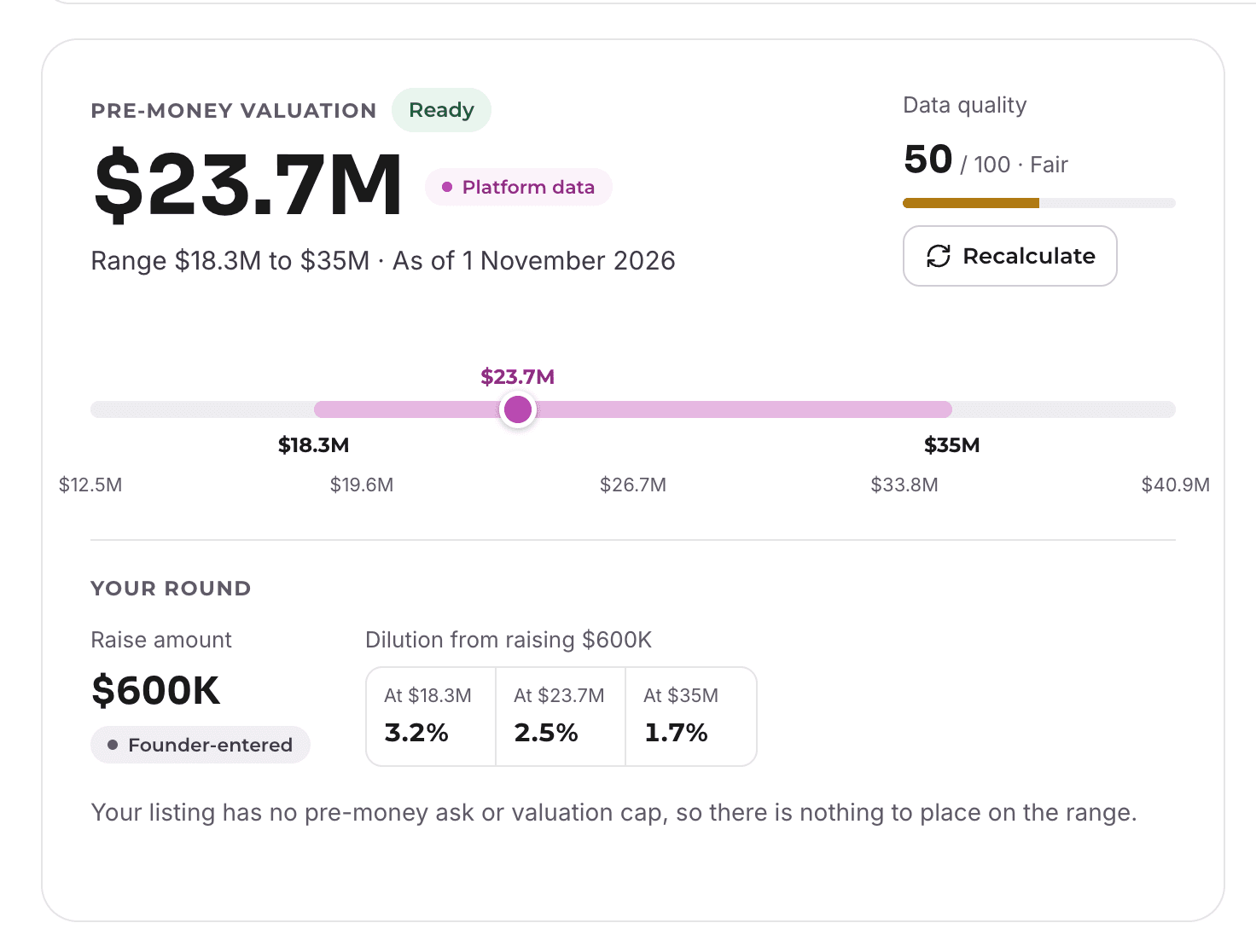
Screen from a live listing on TheAngel, shown with the founder’s permission. The figures are that company’s, not a benchmark.
- Deliverable 02Answers fact 05
Five valuations from six methods, and the blend that becomes your point value
Scorecard, Checklist, the VC method, two DCF variants and revenue multiples, each run separately and shown side by side with its weight. The weights follow your stage: at Development, Scorecard and Checklist carry 60 percent because there is little trading history yet. A method with no data is left out, and the chart says so.
- Six methods, five from market data and your inputs, shown with their weights
- Stage-weighted blend, so a pre-revenue company is not valued like a trading one
- Each method labelled by where its inputs came from: market data or founder-entered
- Method detail: the inputs, their sources, and the method in plain words
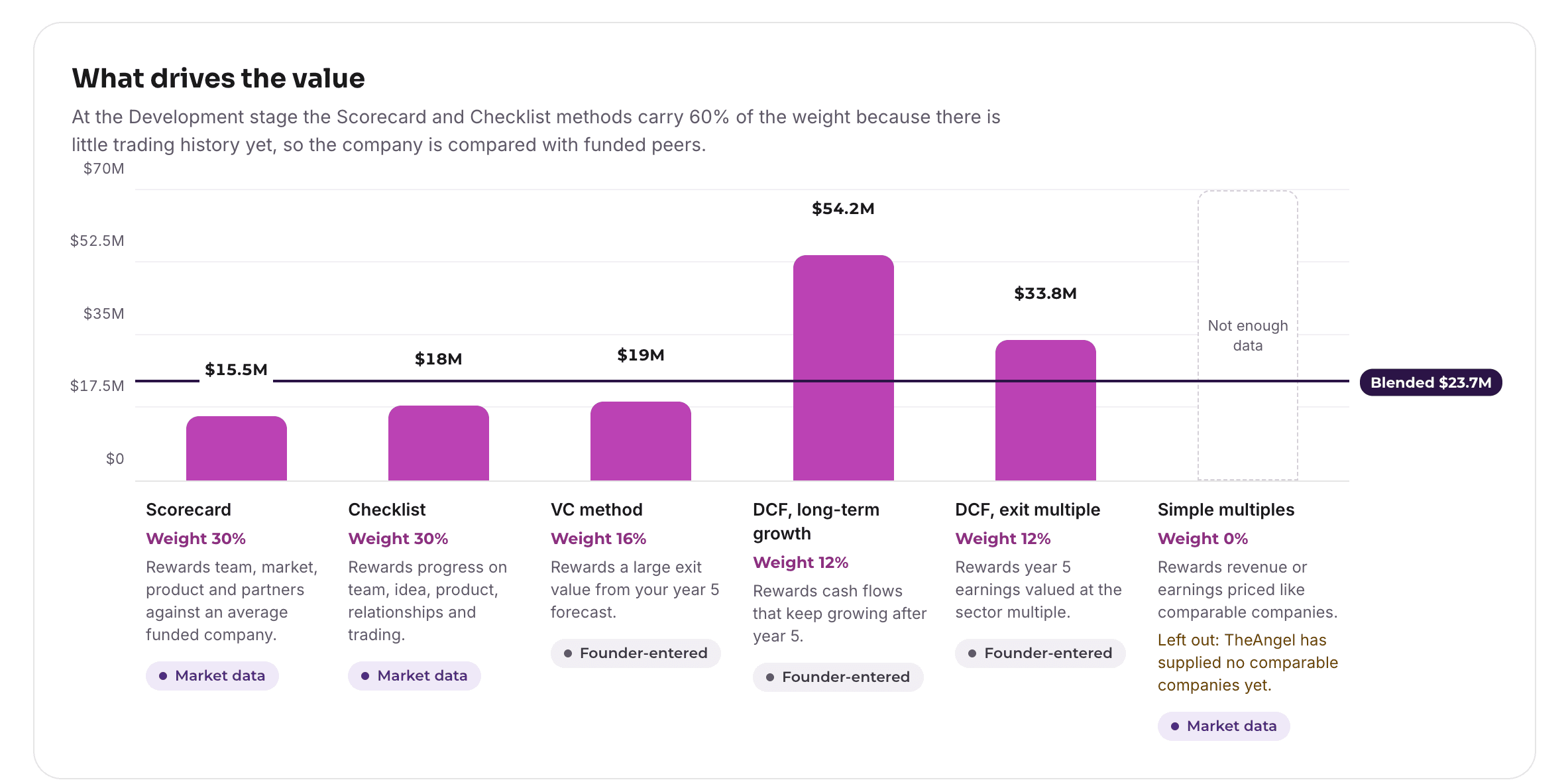
Screen from a live listing on TheAngel, shown with the founder’s permission. The figures are that company’s, not a benchmark.
- Deliverable 03Answers fact 01
Your number against the market benchmark for your stage
The engine uses the median pre-money of US seed rounds as its benchmark and shows where your point value sits against it, as a percentage above or below. You see the source and its date, so you know how fresh the comparison is before an investor asks.
- Median pre-money for your stage, from PitchBook-NVCA, with the data date shown
- Your point value placed on the benchmark line, with the distance in percent
- Benchmark band for your region where regional data is illustrative
- A warning when the market data is more than a year old
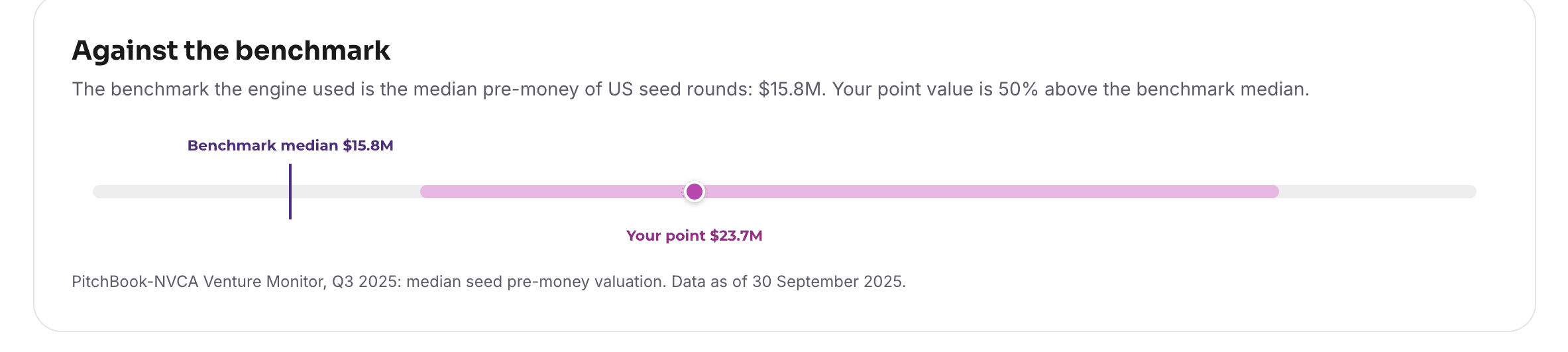
Screen from a live listing on TheAngel, shown with the founder’s permission. The figures are that company’s, not a benchmark.
- Deliverable 04Answers fact 06
Optimise: a ranked list of what would raise the value, with the effect of each
Ten actions for this company, worth up to $3.8M between them. Each one names the method it moves, the evidence that proves it, the effort and the time. Tick actions to see what they could do together. The simulator is clear that the combined effect is not the sum of single effects, and that it is an estimate, not a promise.
- Actions sorted by value per effort, filtered by kind, effort and time
- What proves it: the evidence to add before the action counts
- Simulator: tick actions to see the combined range
- Included on Featured today
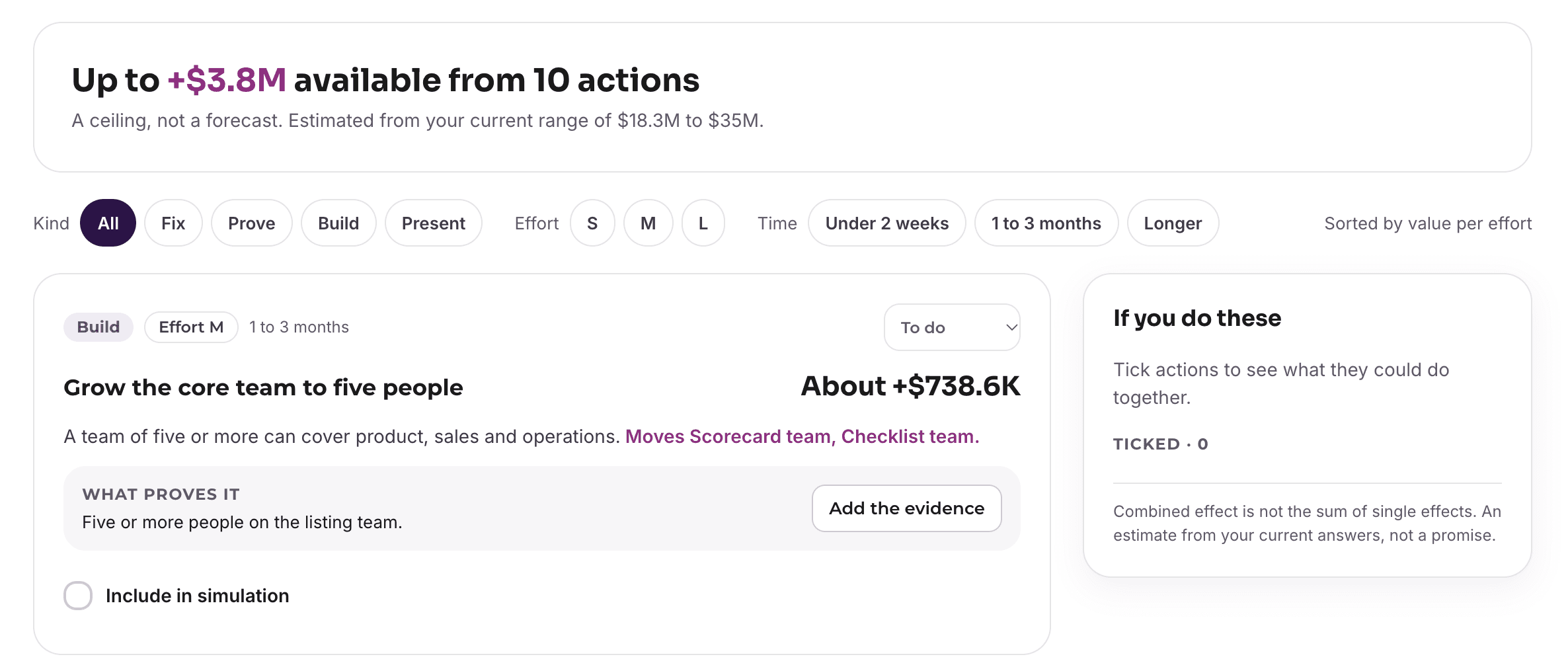
Screen from a live listing on TheAngel, shown with the founder’s permission. The figures are that company’s, not a benchmark.
- Deliverable 05Answers the usual fix
A PDF report of the full working, so you walk in prepared
Download the whole valuation as one document: the point value and range, your round, the checks, the methods and their weights, the benchmark, the sensitivity and the data-quality score. Read it before the meeting and you know every question the number will raise, and the answer. A TheAngel reviewer confirms the range and writes one sentence on the basis.
- Point value, range, your round and the checks, as on the Valuation tab
- Methods, weights, benchmark and sensitivity, so the working is shown
- Your document. Investors see the confirmed range on your listing only, never your point value, inputs or actions
- If a later confirmed run is lower, you have seven days to keep the previous one
THEANGELFor the founderPre-money valuation$23.7MRange $18.3M to $35.0M. Confirmed by a TheAngel reviewer on 31 October 2026.BasisScorecard and checklist carry the weight at this stage. Forecast-based methods are shown but not relied on until a model supports them.1. Point value, range and your roundp. 12. Methods, weights and what each rewardsp. 23. Against the benchmarkp. 34. Fix before you sharep. 45. Sensitivity and data qualityp. 56. Basis of preparation and disclaimerp. 6Illustration of the report’s first page. Layout indicative; the shipped report is being redesigned.
The checks an investor would run, run first.
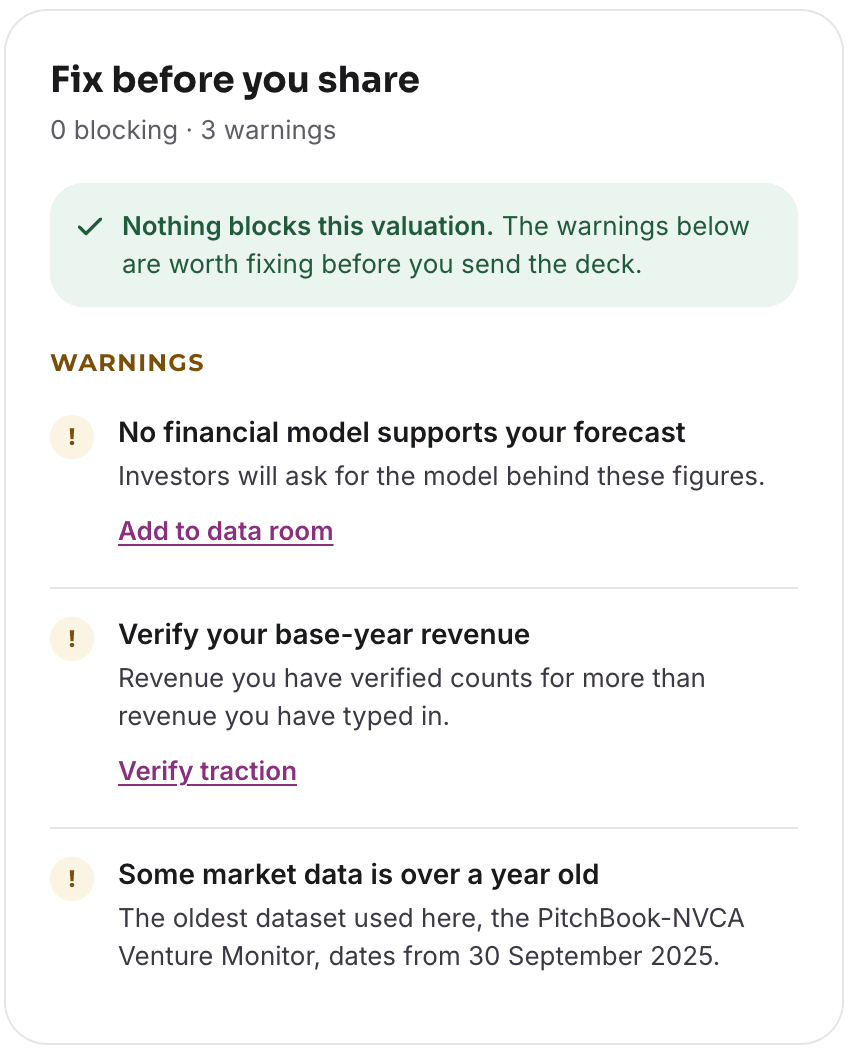
Fix before you share
Blocking issues and warnings, each with a link to fix it. Ask outside the range, forecast above peers, revenue unverified, no model behind the forecast: you hear it here, not in a silent pass.
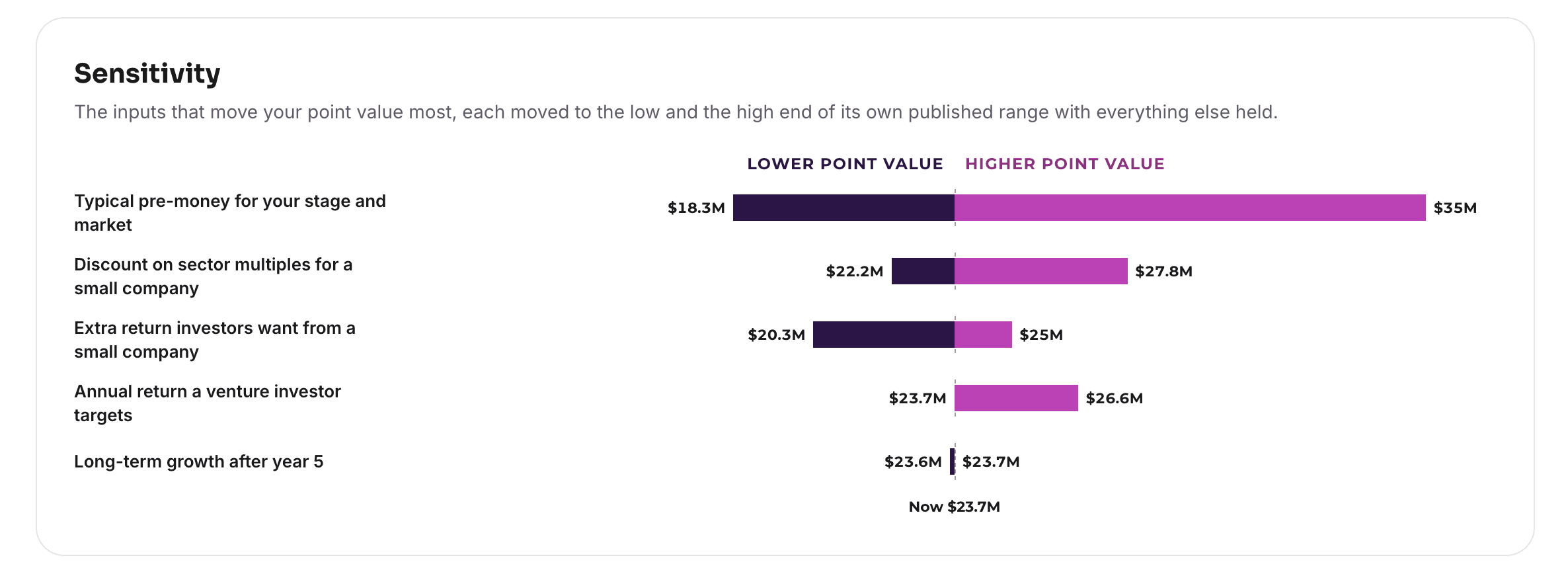
Sensitivity
The five inputs that move your value most, each pushed to the low and high end of its published range. You know which assumption an investor will attack before they do.
History
Every run is kept. The point value at each run, the range as a band, and what changed between them. Recalculate as often as you like; the record shows how the number moved as the evidence improved.
Three steps. Under two seconds to run. Two working days to confirm.
Confirm what we already know
Open the Valuation tab on your listing. The intake is prefilled from what you have already given us. Fill the gaps, confirm the prefills, add your forecast. No financial model yet? You can still run it; the report says so.
Run the valuation
Point value, range, data-quality score, the method blend, your peers, the sensitivity tornado and the checks. Recalculate as often as you like. Every run is kept, so you can see the history.
Get it confirmed and share the range
A reviewer confirms the range and writes the basis. Download the PDF. Switch on investor preview to see exactly what an investor sees. If a later run comes in lower, you have seven days to keep the previous one.
- The valuation range TheAngel confirmed, on your deal page
- That a reviewer confirmed it
- Your point value, your inputs or your method weights
- Your checks, your Optimise actions or your history
On a $3M round, every $1M of pre-money you cannot hold costs you about 1.5 points of the company.
At $12M pre-money you sell 20 percent, the market median. At $9M you sell 25 percent. A founder who opens at $25M, stalls, bridges and closes at $9M has sold a quarter of the company instead of a fifth, and done it six months late.
Modelled from Carta's Q4 2024 medians (priced seed $19.2M post-money on $3.7M raised, 20.0 percent dilution). Illustration, not a forecast.
Valuation is included on Featured.
Less than a founder spends on one coffee meeting with an investor who was never going to say the word price.
Basic
Your listing, the data room, the diligence briefing and a benchmark valuation band. The Valuation tab shows the locked panel.
Featured
- Full valuation: intake, point and range, checks, methods, peers, sensitivity, history
- Reviewer confirmation with a basis line, and the PDF report
- Optimise actions and the simulator, included today
- Everything on Basic, plus investor names on registered interest
Cancel any time. Your listing stays live to the end of the paid period.
Advanced
Everything on Featured, with unlimited investor conversations, 15 direct submissions a month and a re-rate every 48 hours.
Before you decide
Is this what an investor will pay?
No, and nothing is. It is a defensible basis, confirmed as a range, built from your own inputs and public market data. It turns a negotiation about motives into a negotiation about inputs. That is the part founders are missing.
Will investors see my number and anchor low?
They never see the point value, the methods or the inputs. They see only the range TheAngel confirms, and only if the reviewer sets it on your listing. You can switch on investor preview to see exactly what they see.
I am pre-revenue. Is there anything to value?
Yes. Three of the six methods need no revenue: the scorecard, the checklist and the VC method. A method with no data drops out and the others take its weight. The feature is not blocked when there is no financial model; the report tells you where the evidence is thin.
What if the number comes back lower than I hoped?
Then you have learned it here, with the reasons, instead of in thirty silent passes. Optimise lists the actions that raise it and the estimated effect of each. And if a later confirmed run is lower than the one before, you have seven days to keep the previous one.
Is this investment advice?
No. This valuation is an automated estimate from your own inputs and public market data, confirmed by our team as a range only. It is not a fair value opinion, not investment advice, and not a measure of what an investor will pay.
You will sell a fifth of your company in this round. Know what it is worth before anyone else decides for you.
Featured, $29 a month or $299 a year. Investors never see your inputs.
Sources
Carta: State of Private Markets quarterly and annual reports 2023 to 2026; Founder Ownership Report 2025; Peter Walker and Kevin Dowd data posts (seed valuation percentiles, time between rounds, graduation rates, down rounds, dilution, SAFE caps, fundraising cheatsheet). PitchBook-NVCA Venture Monitor, NVCA 2026 Yearbook. BDO UK, Venture Fundraising Report Q3 2023. Gompers, Gornall, Kaplan and Strebulaev, "How Do Venture Capitalists Make Decisions?", Journal of Financial Economics, 2020. PwC Germany, Venture Capital Market Study 2021. NFX Founder Sentiment Report, March 2023. Cooley Venture Financing Reports. All figures US unless stated.
Full source register
1. Seed 95th percentile pre-money $29.9M (Q2 2019) to $72.2M (Q2 2025)
Carta, P. Walker, Top Seed Valuations Hit Record Highs in Q2 2026. 8 Jul 2026
Status: Sourcedcarta.com (source for row 1)
2. Seed median pre-money $8.0M Q2 2019; $15M 2021; $13.7M Q2 2023; $15.0M Q2 2024; $15.6M Q2 2025
Carta State of Private Markets Q1 2025, Q2 2023, Q2 2024, Q2 2025 full reports. 2023 to 2025
Status: Sourcedcarta.com (source for row 2)
3. Ratio 95th to median 3.7x (2019) to 4.6x (2025)
Arithmetic on rows 1 and 2
Status: Derived
4. PitchBook median seed pre-money $6.7M (2019) to $16.0M (2025)
NVCA 2026 Yearbook p.35, data PitchBook. Apr 2026
Status: Sourcednvca.org (source for row 4)
5. 90% misalignment, 32% most of the time, 3% walk away
BDO UK Venture Fundraising Report Q3 2023 (n=40). Sep 2023
Status: Sourcedbdo.co.uk (source for row 5)
6. Valuation important to about half of VCs, most important to under 3%
Gompers, Gornall, Kaplan, Strebulaev, JFE 2020 (n=889). 2016 / 2020
Status: Sourcedconference.nber.org (source for row 6)
7. 59% of investors say valuations too high (UK 75%)
Angel Investment Network survey (n=64). 5 Oct 2026
Status: Sourced (secondary report)itbrief.co.uk (source for row 7)
8. Founder valuations rated 8.02 of 10 (10 = far too high)
Wessendorf and Hammes, KIT (n=54). 2017
Status: Sourcedpublikationen.bibliothek.kit.edu (source for row 8)
9. Seed to A median 1.5 yrs (2019), 2.1 yrs (2024, 2025), 1.9 yrs (Q4 2025)
Carta 2025 in review; Q4 2024 report; Walker early 2026. Feb 2025 to Feb 2026
Status: Sourcedcarta.com (source for row 9)
10. 3+ years seed to A: 19% (Q3 2019) to 39% (Q3 2025)
Carta, P. Walker (3,365 startups). 28 Oct 2025
Status: Sourcedcarta.com (source for row 10)
11. Two-year graduation: Q4 2019 32.6%; 2021 17.6%; Q1 2022 12.1%; none above 30% since Q3 2021
Carta, P. Walker, four posts. Nov 2023 to Feb 2026
Status: Sourcedcarta.com (source for row 11)
12. Seed bridge share 31% (2022) to 46% (Q1 2025); bridged companies reach A half as often
Carta Q1 2025 full report; Walker 23 May 2025. 2025
Status: Sourcedcarta.com (source for row 12)
13. Down rounds 5% (2021), 19.7% (2023), 24.2% (Q1 2024), 20% (2024), under 14% (Q4 2025)
Carta, P. Walker posts; State of Private Markets 2025 in review. 2023 to 2026
Status: Sourcedcarta.com (source for row 13)
14. Cooley quarterly down-round share Q4 2022 to Q4 2025
Cooley Venture Financing Reports. quarterly
Status: Sourcedcooleygo.com (source for row 14)
15. PitchBook 2025: 14.3% down, 20.9% down or flat
PitchBook 2025 Annual US VC Valuations and Returns Report. 10 Feb 2026
Status: Sourcedpitchbook.brightspotcdn.com (source for row 15)
16. Founder ownership 56.2% after seed, 36.1% after A, 23% after B, 10.3% after D
Carta Founder Ownership Report 2025. 21 Jan 2025
Status: Sourcedcarta.com (source for row 16)
17. Seed dilution median about 20% since 2021, 75th pct under 25%; 19.5% in 2025
Carta, P. Walker (9,600+ and 5,118 rounds). 4 Sep 2024; 9 Aug 2025
Status: Sourcedcarta.com (source for row 17)
18. One in five founding teams hold 50%+ after Series A
Carta, P. Walker (3,500+ startups). 11 Jul 2025
Status: Sourcedcarta.com (source for row 18)
19. Priced seed $19.2M post on $3.7M, 20.0% dilution (Q4 2024)
Carta fundraising cheatsheet (1,466 rounds). 9 Feb 2025
Status: Sourcedcarta.com (source for row 19)
20. Nearly 80% of investors say valuation depends significantly on negotiation (2021), 70% (2020)
PwC Germany Venture Capital Market Study 2021. 2021
Status: Sourcedpwc.de (source for row 20)
21. $500K to $999K raises: median $10M cap, some $30M with similar traction
Carta, P. Walker, Preseed Caps Are Unfair and Not Data-Driven. 20 Sep 2025
Status: Sourcedcarta.com (source for row 21)
22. 49% of raise attempts unsuccessful; 71% of raises took 3 to 12 months
NFX Founder Sentiment Report (n=870). 20 Mar 2023
Status: Sourcednfx.com (source for row 22)
23. $3M raise: 20.0% at $12M pre, 25.0% at $9M pre; about 1.5 points per $1M
Arithmetic on row 19 medians
Status: Modelled: round-size and pre-money assumptions / Source Capital analysis
24. Seed pre-seed SAFEs 90% of pre-seed rounds (Q1 2025)
Carta State of Pre-Seed Q1 2025. 20 May 2025
Status: Sourced (context only)carta.com (source for row 24)
The Angel App Ltd. This page is not investment advice. Valuation ranges shown to investors are confirmed by TheAngel as ranges only and are not fair value opinions.