MightyFly

Autonomous eVTOL aircraft disrupting the $300B+ expedited delivery market

Autonomous eVTOL aircraft disrupting the $300B+ expedited delivery market

$3,422,601

68% raised of $5M max

1,979

Investors

🔥 42 hours

Left to invest

$250 minimum investment

Highlights

Autonomous hybrid-electric aircraft disrupting a $300B+ expedited delivery
$50M signed contract; $230M in letters of intent (LOIs); $1M+ revenue
$100M+ projected revenue within 5 years; Recurring/subscription model
3 aircraft generations in 3 years; 400+ autonomous flights; USAF demo
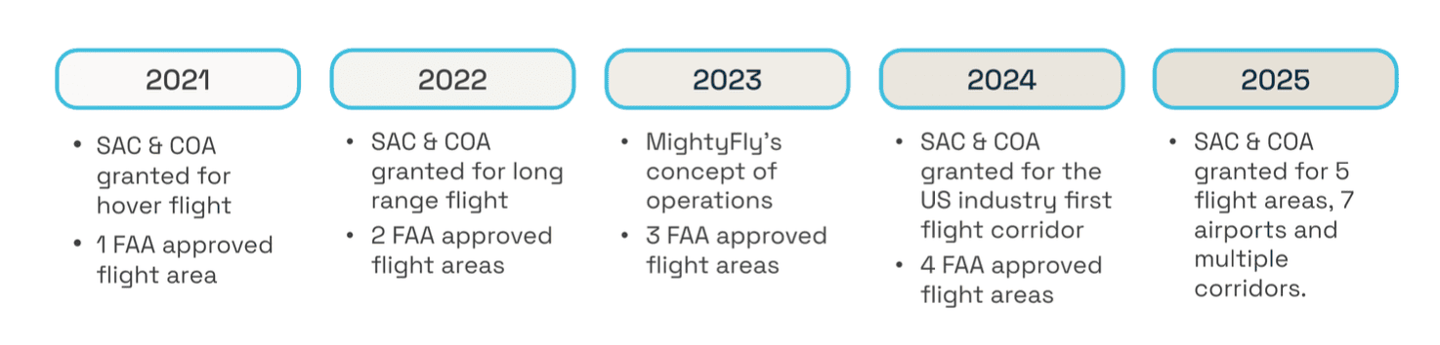
FAA approvals for 5 flight areas and multiple corridors
Strong federal tailwinds (recent presidential EO on eVTOL integration)
$10M+ raised from top-tier Silicon Valley investors

Notable Existing Investors

The Executive Summary

Breaking the $319B market into high-margin profitability

MightyFly is the leading B2B/B2G last-mile and middle-mile delivery company with dual-use autonomous hybrid eVTOL aircraft targeting 100–500 pounds cargo capacity, across 600–1,000 miles range, with multi-stop per flight route, which provides customers with fast, low-emission and affordable deliveries.

The company’s business model is a subscription-based expedited delivery service. Given its aircraft range, payload, and autonomy, MightyFly’s unit economics are highly favorable: operating cost-per-mile is projected to be ~65% lower than current options. In parallel, MightyFly also serves government and defense customers through both aircraft sales and on-demand delivery services.

MightyFly’s timing aligns perfectly with the recently announced FAA commercial and eVTOL rules, enabling rapid expansion into the $319 billion expedited-delivery market. MightyFly has already developed three full-scale aircraft, completed over 400 autonomous flights, and obtained a Special Airworthiness Certificate covering multiple flight areas, corridors, and airports.

The company has also generated over a million dollars in revenue, signed a $230 million LOI and, most recently, a $50 million contract.

The Opportunity

Expedited delivery suffers from slow, costly, and inefficient service
Commercial deliveries:

  • Too slow due to traffic and multi-segment hub-and-spoke model
  • Too costly due to low loading factor, and empty vehicle return runs at $1.70/mile
  • High emissions from poor gas mileage and low vehicle utilization
  • High labor dependency affected by shortage of drivers and pilots

Defense deliveries:

  • Lacks resilient, infrastructure independent, relatively low cost, autonomous aircraft to meet DoD’s logistics needs

Solution

Unlocking expedited logistics with autonomous hybrid electric aircraft

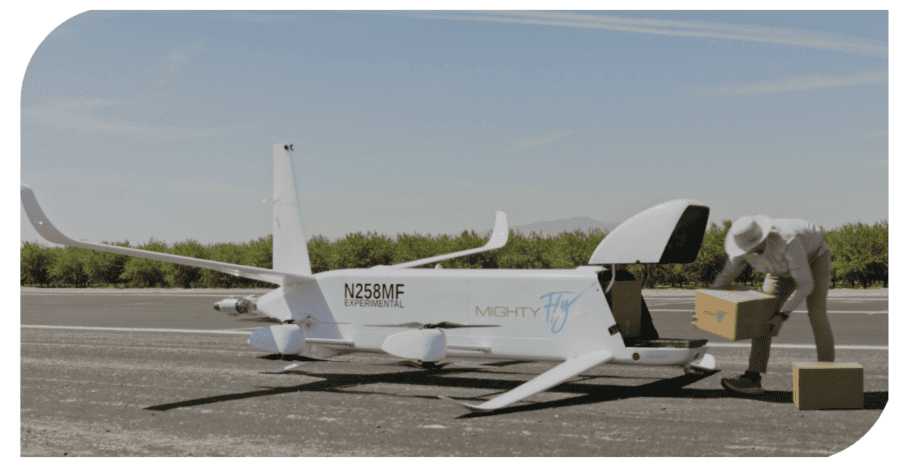
MightyFly develops and operates large, autonomous delivery aircraft designed to move cargo quickly and efficiently for businesses and governments.

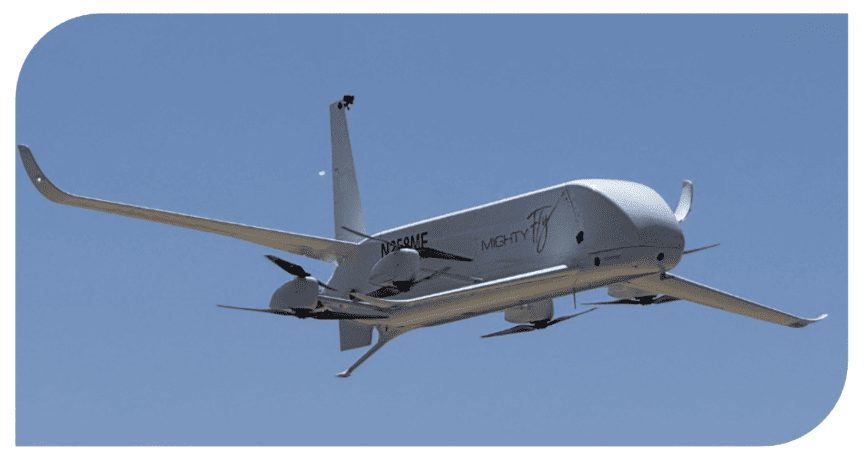
Their hybrid-electric aircraft takes off and lands vertically, with target cargo capacity of 100–500 pounds, range of 600–1,000 miles and maximum speed of 150 mph, enabling deliveries much faster than traditional vans while also lowering operating costs and emissions.

They are working on launching same-day services for medical test kits, time-sensitive manufacturing shipments, inter-island deliveries, and other B2B deliveries, while expanding their DoD contracts.
Built-for-purpose:

  • eVTOL: parking lot or roof top; no vertiports required
  • Multi pick-up and drop-offs for high-capacity utilization
  • 100-500 pound cargo capacity
  • 600-1000 mile range
  • 150 mph max speed
  • Relatively quiet for urban deliveries

Milestones Achieved:

  • US Air Force Demo
  • 400+ autonomous test flights
  • Autonomous loading and unloading, as shown in the US Air Force demo video
  • 3 generations of aircraft developed in 3 years

Regulatory: Clear path for commercial takeoff

All FAA approvals obtained for next stage of growth

  • MightyFly has secured multiple FAA-approved flight areas, corridors and airports in the US
  • Part 108 rules enabling Beyond Visual Line of Sight (BVLOS) commercialization, published by the FAA
  • Parallel track targeting public aircraft operation and DoD with no FAA Approvals required
Strong Commercial Traction

$50 million healthcare contract with growing dual-use revenue

$50 million Signed 5 Years Contract to Provide Accessible Healthcare

  • Their commercial customer supplies medical test kits to businesses, which must be shipped back the same day or the next day after consumer use
  • Customer’s delivery cost exceeds the cost of their tests.
  • Contract value calculated using the minimum per-delivery cost multiplied by the projected number of deliveries over the 5-year contract
  • Customer is an entry point to major medical retailers and hospitals, which rely heavily on expedited delivery for items like tests, blood, donor tissue, and surgical kits
  • Retail health kit distribution

Qualified for $15M Air Force Strategic Funding Increase (STRATFI) With Successfully Completed Phase II Contract

  • $1.3 million paid, completed two contracts with the US Air Force, AFWERX, AMC and Agility Prime
  • Demonstrated autonomous flight and cargo handling, including autonomous nose opening and closing, package positioning and locking, aircraft weight and balance, and autonomous flight
  • Unlocking 1,000 mile range, 100 pound payload, eVTOL, distributed, expedited autonomous logistics
First Public Intra City Demonstration Planned for 2026

  • $150k paid POC
  • Contract with Michigan Office of Future Mobility and Electrification (OFME)
  • First known commercial public demo of large autonomous cargo eVTOL in the US

$220M Signed LOI for Hawaii Inter-Island Deliveries

  • Topographical limitations forces nearly 100% of expedited deliveries to be via air freight
  • Minimum pricing for package deliveries in Hawaii is almost 2x that in the continental U.S.
  • Customers have to deliver expedited packages to airports themselves
  • LOI value based on the estimated initial Proof of Concept (POC) cost, the sale of 15 aircraft, and 20 years of expedited delivery service.

Growth Trajectory

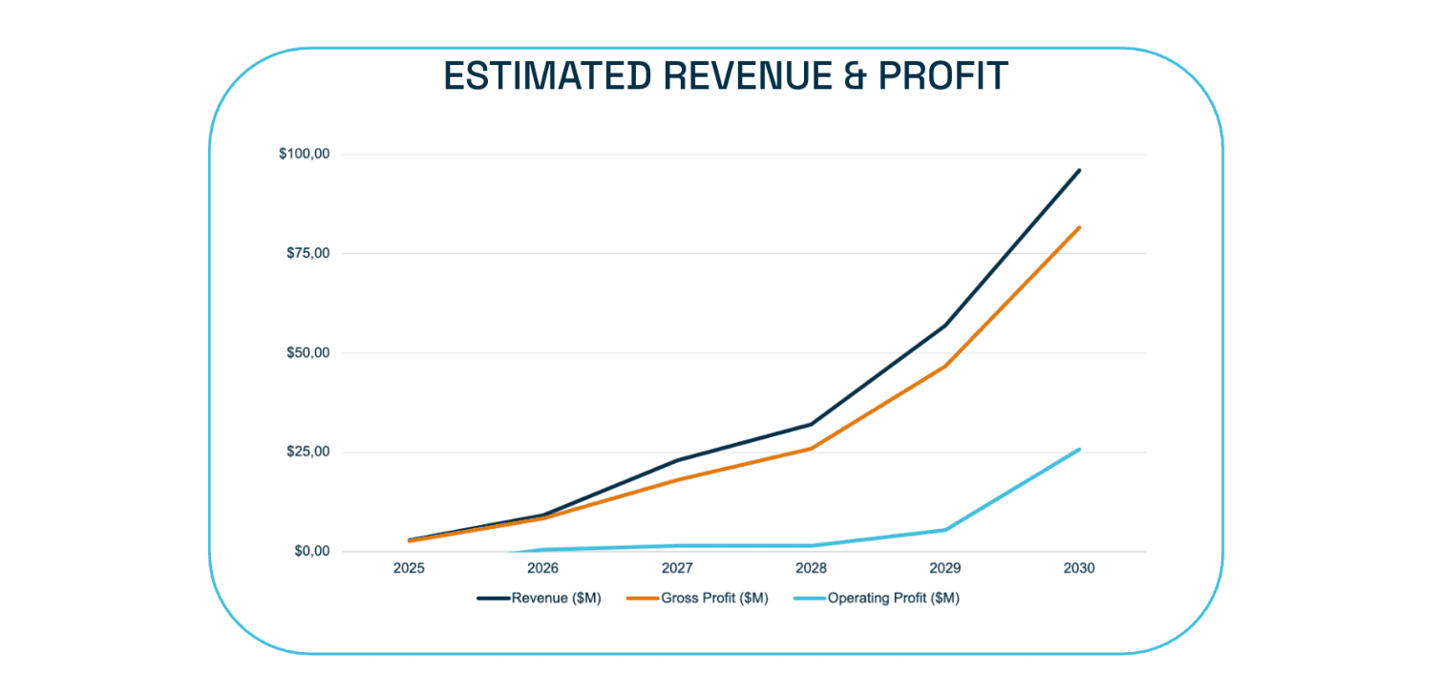
Projected ~$100M 5 year revenue

  • Dual Revenue Channels: Subscription B2B/B2G services and DoD contracts
  • $10M per aircraft lifetime revenue; ~$1M/year; ~1 year ROI
  • Efficient market penetration driven by increased speed, decreased cost, reduced emissions, and frictionless customer integration
  • AI extensions to unlock capabilities, such as route optimization and fire detection, to expand beyond the $319B market
Disruptive Unit Economics

Creating fast, capital-efficient and distributed expedited logistics

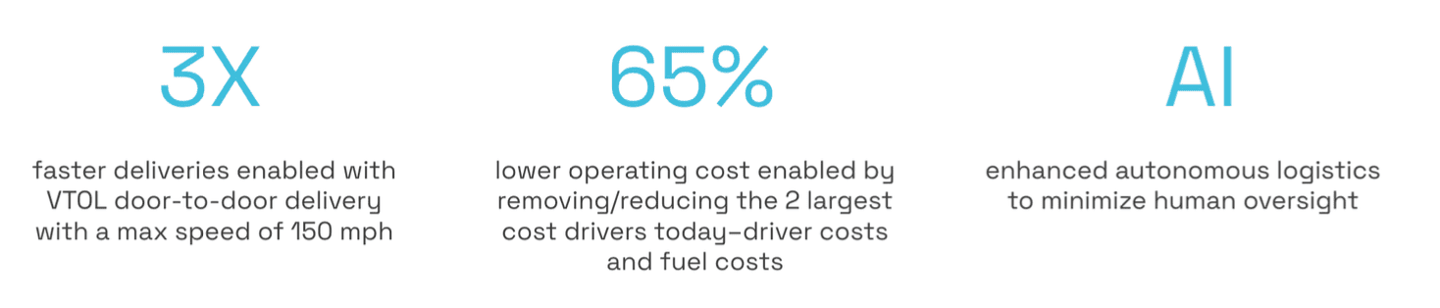
At least 3x Faster with 65% lower opex compared to conventional logistics operators, and AI-enhanced logistics operations with exponential efficiency upside
CO2e Impact

Decarbonizing aviation and logistics

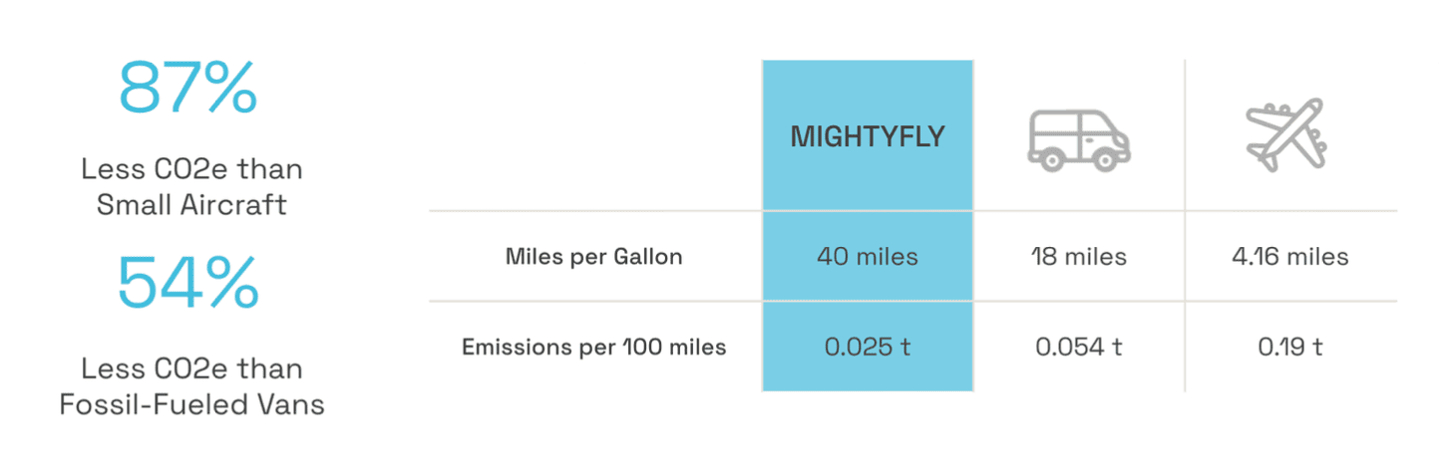
MightyFly’s hybrid propulsion system estimated emissions reductions:
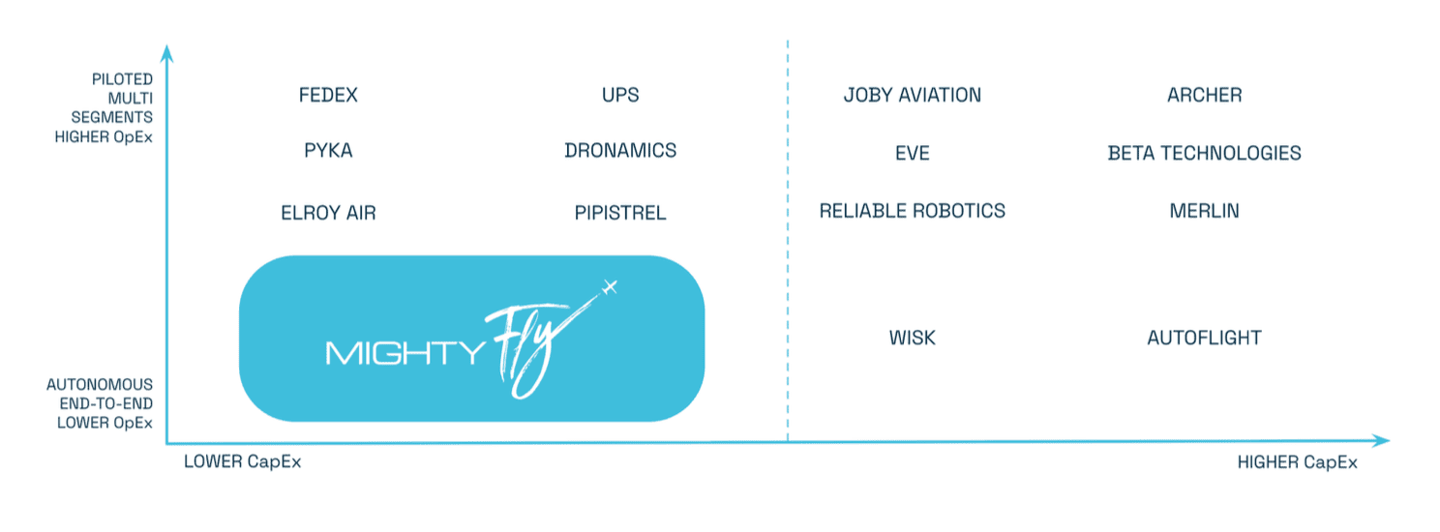
Competitive Landscape

The only large-autonomous-cargo eVTOL with multi-stop
Leadership

Aerospace and autonomy experts and leaders
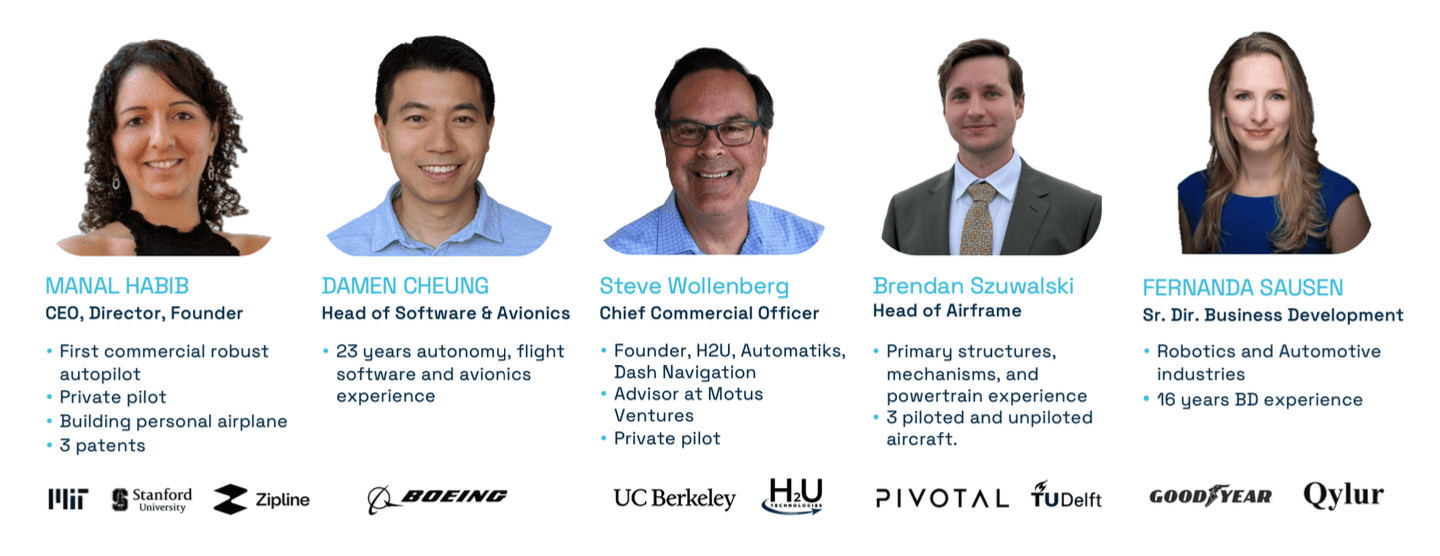
Manal Habib is the CEO and founder of MightyFly and a pioneer of the drone industry. A graduate from both MIT (bachelor of science in aerospace engineering) and Stanford (graduate program in aerospace engineering), Habib has developed a strong technical background in aerospace engineering. She previously specialized in flight controls and worked on the development of the first robust commercial flight controller. Manal is also a private pilot and in the process of building her own airplane. Her passion for aerospace, vision for a better world, and determination make her a motivated and unstoppable entrepreneur and leader. Manal holds two patents (one granted and one provisional).

Damen Cheung is the Head of Software and Avionics at MightyFly. He holds a Master’s degree in Electrical and Computer Engineering from Georgia Tech and has 23 years of experience in autonomy, flight software and avionics integration. He previously led numerous software teams at Boeing across various military and commercial aviation programs. His specializations include real-time embedded software, hardware/software integration, automated testing, communication networks, and safety critical systems.

Brendan Szuwalski is the Head of Airframe at MightyFly. He holds a Master’s Degree in Vehicle Engineering from TU Delft and a Bachelor’s Degree in Mechanical Engineering from Johns Hopkins. He has worked in the development of three aircraft projects, from design to autonomous flight, in the Part 103 ultralight and Class 3 UAV categories. His specialities include primary structures, mechanisms, and powertrain development.

Steve Wollenberg is the Chief Commercial Officer at MightyFly. He brings over 30 years of experience in business development, sales, operations, and engineering in the robotics, mobility, and renewable energy sectors. Steve is a serial entrepreneur, having co-founded and grown 4 start-ups in silicon valley, with successful exits and partnerships.

Fernanda Sausen is the Senior Director of Business Development at MightyFly. She holds a Master’s Degree in International Relations and brings to MightyFly over 15 years of experience in sales, partnerships and operations in the robotics, automotive, aviation and hospitality sectors. Fernanda has led worldwide business development, operations and commercial deployments, including customer projects at Disneyland Paris, Statue of Liberty, Rio 2016 Olympic Games, Brazil 2014 FIFA World Cup, and Europa Park.

🔥 26 hours left to invest

Deal terms

The maximum valuation at which your investment converts into equity shares or cash.
Learn more.
If a trigger event for MightyFly occurs, the discount provision gives investors equity shares (or equal value in cash) at a reduced price.
Learn more.
The smallest investment amount that MightyFly is accepting.
Learn more
100% of $1M minimum offering amount has been reached.

MightyFly must achieve its minimum goal of $1M before the deadline.

The maximum amount the offering can raise is $5M.

Learn more

A SAFE allows an investor to make a cash investment in a company, with rights to receive certain company stock at a later date, in connection with a specific event.
Learn more
MightyFly needs to reach their minimum funding goal before the deadline (11:59pm PST on December 18th). If they don’t, all investments will be refunded.

Learn more.

Documents

Republic (OpenDeal Portal LLC, CRD #283874) is hosting this Reg CF securities offering by MightyFly Inc. View the official SEC filing and all updates:

Company documents

About MightyFly

Legal Name

MightyFly Inc

Founded

Oct 2019

Form

Delaware Corporation

Employees

10

Website

Social Media

Headquarters

MightyFly Team

Everyone helping build MightyFly, not limited to employees

Manal Habib

Founder & CEO

Steve Wollenberg

Chief Commercial Officer

Fernanda Sausen

Senior Director, Business Development

Damen Cheung

Head of Software and Avionics

Brendan Szuwalski

Head of Airframe

Christopher Wolfgram

Staff Mechanical Engineer

Clemens Kruse

Staff Electrical Engineer

Sanchit Nawal

Senior Aircraft Design & Aerodynamics Engineer

Mike Battle

Master Composites Technician

Lance Carter

Staff Guidance, Navigation, and Control Engineer

John Formisano

Advisor and Retired VP of FedEx

Jim Travis

Advisor and Retires USAF Colonel

Jon Foster

Advisor, advisor to McKinsey, Former CFO of Zoox

Barbara Piette

Advisor and Former Managing Partner

Dan Gilbert

Advisor and Retired COO

Press

  • Savills Forecasts UK House Prices to Continue to Rise Over Next 5 Years
    Categories: Blog, Market Updates

    Coinbase monitors the tokens we list to ensure they remain aligned with our listing standards.

  • Coinbase Launches the Coinbase 50 Index: A Global…
    Categories: Blog, Product

    Coinbase Launches the Coinbase 50 Index: A Global Crypto Benchmark Tl;dr Coinbase launched the Coinbase 50 Index [...]

  • Getting Started Step 1 – Register Your Fractionex Account
    Categories: Getting Started, Learn

    How to Create a Fractionex Account The initial account set up could not be easier and will [...]

  • Getting Started Step 6 – Receive Your Revenue Distribution
    Categories: Getting Started, Learn

    Getting Started Step 6

  • Getting Started Step 5 – Buy Your First Property Token
    Categories: Getting Started, Learn

    Getting Started Step 5

  • Getting Started Step 4 – Navigate the Dashboard
    Categories: Getting Started, Learn

    Getting Started Step 4

FAQ

Which countries or states are not permitted to open a Custody Account with BitGo?
  • Anguilla

  • Belarus

  • Belgium

  • Bermuda

  • Bonaire, Sint Eustatius and Saba

  • Cuba

  • El Salvador

  • France

  • Grenada

  • Guadeloupe

  • Haiti

  • India

  • Indonesia

  • Iran

  • Israel

  • Jamaica

  • Japan

  • Montserrat

  • North Korea

  • Qatar

  • Russia

  • Saint Kitts and Nevis

  • Syria

  • Turks and Caicos Islands

  • Venezuela

  • Vermont, USA

  • Companies will utilize a custodian to ensure that all securities they offer in their campaign are in one place. This means if a liquidity event or any other material event in respect to the securities occurs, the company can look to the custodian to service the securities, rather than each individual investor.

  • For investors, utilizing a custodian safeguards their investment, or security interest, with a qualified financial institution. Having a custodial account allows for easier transfers and creates additional layers of protection for your securities. For companies, it can increase efficiency by reducing their cap table management costs and creating a single-line item, making future funding rounds easier. 

  • Right now, there are no costs for investors to open a custodial account.
  • Custodial accounts do sometimes have a low annual cost to maintain; however, such costs are covered for the investor in this offering at this time.
BitGo reviews accounts that require manual review on a daily basis. Please expect to receive confirmation of your account being opened or to hear further guidance from our team within 24-48 hours.
Yes, since the company is utilizing a custodian, all investors in the offering will be required to create a custodial account with BitGo Trust Company and enter into an omnibus nominee agreement.

The custodial account creation process is hosted in our investment checkout system, meaning you will commit your investment and establish your account with BitGo all at once. During investment checkout, you will be automatically prompted to review and sign certain custodial documents with BitGo. In addition, you may be asked to provide certain information to verify your identity. Once completed, you will receive an email confirming your investment commitment.

Companies will utilize a custodian to ensure that all securities they offer in their campaign are in one place. This means if a liquidity event or any other material event in respect to the securities occurs, the company can look to the custodian to service the securities, rather than each individual investor.

For investors, utilizing a custodian safeguards their investment, or security interest, with a qualified financial institution. Having a custodial account allows for easier transfers and creates additional layers of protection for your securities. For companies, it can increase efficiency by reducing their cap table management costs and creating a single-line item, making future funding rounds easier.

A custodian is a qualified third-party entity that acts as a legal holder of securities. An investor will open a custodial account with the qualified custodian, which is used to hold investments, namely the securities in a company. A custodial account allows you to name a beneficiary and accept payments such as dividends distributions or cash payouts. Custodial accounts are not managed or held by Republic; instead, they are managed by the custodian who works with the issuer raising on the platform. The custodian of this offering is BitGo Trust Company.

We are using Republic’s SAFE security. Learn how this translates into a return on investment here.

Still have questions? Check the discussion section.

Risks

If the Target Offering Amount is met after 21 calendar days, but before the Offering Deadline, the Issuer can end the Offering by providing notice to Investors at least 5 business days prior to the end of the Offering. This means your failure to participate in the Offering in a timely manner, may prevent you from being able to invest in this Offering – it also means the Issuer may limit the amount of capital it can raise during the Offering by ending the Offering early.

The Issuer is still in an early phase and we are just beginning to implement our business plan. There can be no assurance that we will ever operate profitably. The likelihood of our success should be considered in light of the problems, expenses, difficulties, complications and delays usually encountered by early stage companies. The Issuer may not be successful in attaining the objectives necessary for it to overcome these risks and uncertainties.

In addition, our drones, eVTOL aircraft and other products are sold or will be sold in new and rapidly evolving markets. Accordingly, our business and future prospects may be difficult to evaluate, the extent to which demand for our products and services will increase, if at all, could be impacted by our ability to do the following:

  • attract new customers to our products or services;

  • develop, renew and expand contracts;

  • acquire and maintain market share;

  • attract, integrate, train and retain leadership and other highly qualified personnel;

  • achieve or manage growth in our operations;

  • acquire new technologies;

  • adapt to required redirection or changes in services or direction caused by geopolitical crises;

  • successfully develop and commercially market new products and services;

  • keep pace with technological developments;

  • timely address the increasingly sophisticated needs of our customers, including as a result of changes in government regulation related to our products and services;

  • secure sufficient quantities or cost-effective production of our products due to supply chain challenges;

  • adapt to new or changing policies and spending priorities of governments and government agencies;

  • generate sufficient revenue to achieve or maintain profitability; and

  • access initial and additional capital when required and on reasonable terms.

If we fail to address these and other challenges, risks and uncertainties successfully, our business, results of operations, prospectsandfinancialconditionwouldbemateriallyharmed.

The defense and broader aerospace industry is highly competitive and generally characterized by intense competition to win contracts. While we expect to be one of the pioneering companies to market eVTOL aircraft, we expect this industry to be increasingly competitive, and it is possible that our competitors could get to market before us, either generally or in specific markets. Our current principal competitors may include Elroy Air, Inc. and Pipistrel (a part of Textron eAviation, a business segment of Textron Inc.).

Many of these companies may have substantially greater financial, management, research and marketing resources than we do. Our competitors may be able to provide customers with different or greater capabilities or benefits than we can provide in areas such as technical qualifications, past contract performance, geographic presence, price and the availability of key professional personnel, including those with security clearances. Furthermore, many of our competitors may be able to utilize their substantially greater resources and economies of scale to develop competing products and technologies, manufacture in high volumes more efficiently, divert sales away from us by winning broader contracts or hire away our employees by offering more lucrative compensation packages. In particular, our competitors may be able to obtain the relevant certification and approvals for their aircraft before us. Small business competitors may be able to offer more cost competitive products and services, due to their lower overhead costs, and take advantage of small business incentives and set-aside programs for which we are ineligible. In order to secure contracts successfully when competing with larger, well-financed companies, we may be forced to agree to contractual

terms that provide for lower aggregate payments to us over the life of the contract, which could adversely affect our margins.

The defense and broader aerospace industry continues to undergo significant changes, primarily due to technological developments. Because of the rapid growth and advancement of technology, shifting our “business to business” (B2B) consumer tastes and the popularity and availability of other forms of activities, it is impossible to predict the overall effect these factors could have on potential revenue from, and profitability of, the defense and broader aerospace industry. The development of specialized software and hardware is a costly, complex and time-consuming process, and investments in product development often involve a long wait until a return, if any, can be achieved on such investment. We might face difficulties or delays in the development process that will result in our inability to timely offer products that satisfy the market, which might allow competing products to emerge during the development and certification process. We anticipate making significant investments in R&D relating to our products and technology, but such investments are inherently speculative and require substantial capital expenditures. Any unforeseen technical obstacles and challenges that we encounter in the R&D process could result in delays in or the abandonment of product commercialization, may substantially increase development costs, and may negatively affect our results of operations. In the time it takes to develop or improve upon a product, that product may become obsolete.

It is impossible to predict the overall effect these factors could have on our ability to compete effectively in a changing market, and if we are not able to keep pace with these technological advances, then our revenues, profitability and results of operations may be materially adversely affected. However, if we struggle to adapt to an industry-shifting technological advancement or competitor offerings that render our products relatively less attractive or obsolete, including due to competitive pressures we face relative to other drone companies, it could have a material adverse effect on our business.

Further, we rely on and will continue to rely on components of our products that are developed and produced by other companies over which we have limited control. The commercial success of certain of our planned future products will depend in part on advances in these and other technologies by other companies, and our ability to procure them from such third parties in a timely manner and on economically feasible terms. We may, from time-to-time, contract with and support companies developing key technologies in order to accelerate the development of such products for our specific uses. Such activities might not result in useful technologies or components for us.

Our products and services are highly sophisticated and specialized, involve complex advanced technologies, are often integrated with third-party products and services, and are utilized for specific purposes that require precision, reliability, and durability. Many of our products and services include both hardware and software that involve industrial machinery and intricate aviation and defense systems, including commercial and military jet engines, power and control systems, and other aircraft parts, and military sensors and command and control systems. Technical, mechanical, quality, electronic, and other failures may occur from time to time, whether as a result of manufacturing or design defect, operational process, or production issue attributable to us, our customers, suppliers, partners, third party integrators, or others. Product design changes and updates could also have associated cost and schedule impacts. In addition, our products could fail as a result of cyber-attacks, such as those that seize control and result in misuse or unintended use of our products, or other intentional acts. The impact of a catastrophic product or system failure or similar event affecting our or our customers’ or suppliers’ products or services could be significant, and could result in injuries or death, property damage, loss of strategic capabilities, loss of intellectual property, loss of reputation, and other significant negative effects. A product or system failure, or perceived failure, could lead to negative publicity, a diversion of management attention, and damage to our reputation that could reduce demand for our products and services. It could also result in product recalls and product liability and warranty claims (including claims related to the safety or reliability of our products) and related expenses, other service, repair and maintenance costs, labor and material costs, customer support costs, significant damages, and other costs, including fines and other remedies, and regulatory and environmental liabilities. We may also incur increased costs, delayed payments, reputational harm, or lost equipment or services revenue in connection with a significant issue with a third party’s product with which our products are integrated. Further, our insurance coverage may not be adequate to cover all related costs and we may not otherwise be fully indemnified for them. Any of the foregoing could have a material adverse effect on our competitive position, results of operations, financial condition, or liquidity.

Show all Risks

Discussion

Ask questions and share feedback with the MightyFly team below. If you have support related questions for Republic, please contact investors@republic.co.

[trustindex no-registration=google]